Story
In our digital economy, the enterprise digital transformation is not just a need for an elite group of pioneers or enlightened businesses: it is essential for any company to remain competitive and relevant in the market. It is not surprising, therefore, that digital transition itself, in its different types, continues to receive significant public funding. Among the most compelling tools to accelerate this transformation are APIs (Application Programming Interfaces).
What are APIs and why they promote digital transformation in enterprises
Let’s take a step back and define APIs: APIs are a set of rules and protocols embedded in an application layer that allow communication between different software systems and facilitate the exchange of information.
From an operational point of view, APIs enable the efficient, and secure, exposure of data and services according to predefined and universal standards. This applies to both internal communications, i.e. between departments, offices, or subsidiaries, and external communication, such as when data is offered to business partners.
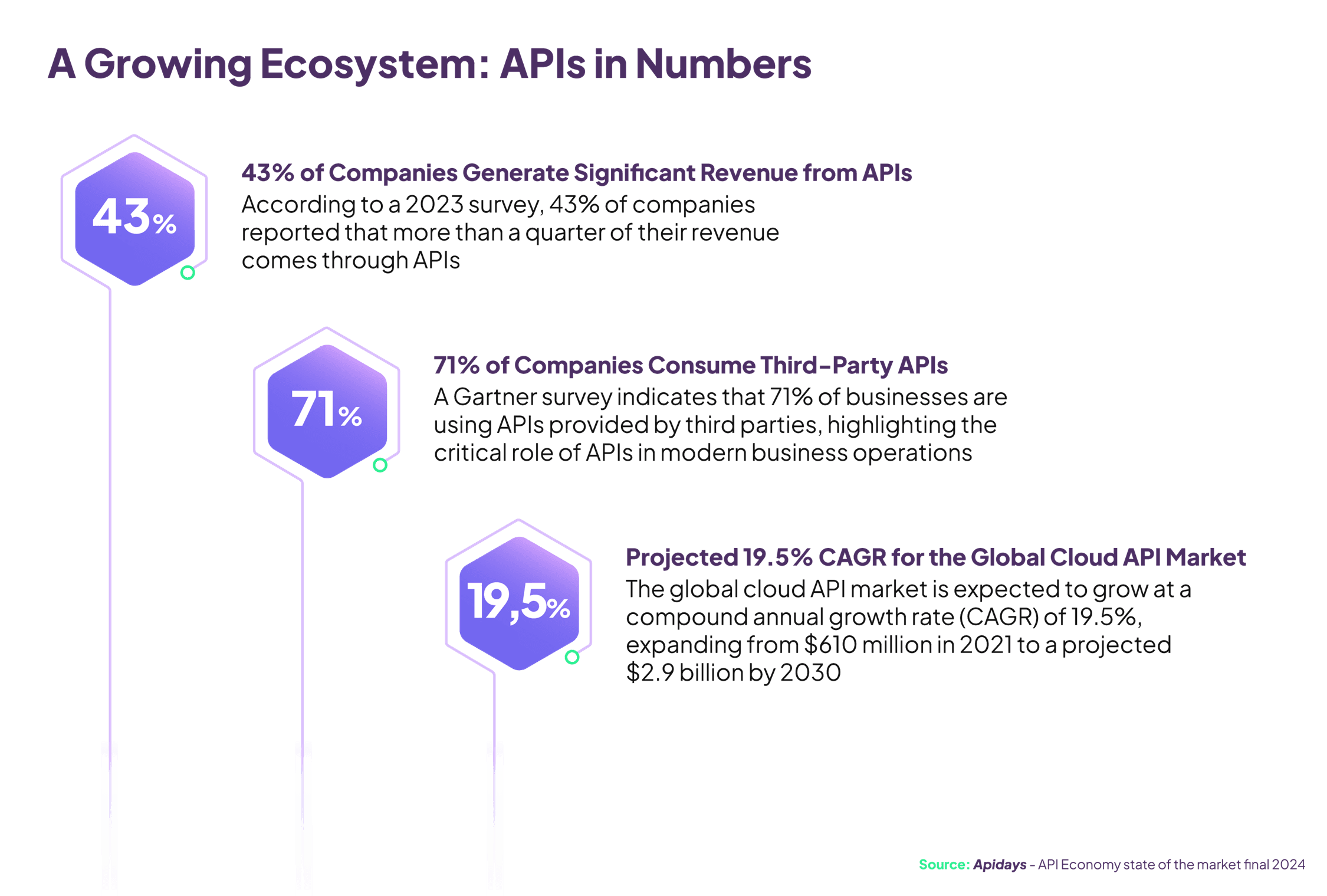
In essence, APIs allow for optimal data flow management, ensuring a degree of control over these flows that is hard to achieve with other tools. This creates two major opportunities for companies: first, their communications become more efficient, speeding up adoption and improving efficiency; and secondly, but not less important, they can tap into monetization models. This is significant not only for companies that are enabled to expose innovative or competitive services, but also for those that simply have high-value data in a particular sector. This specific opportunity has given rise to the Data as a Service (DaaS) paradigm, which describes a business model where companies make their data available to third parties as a service.
The key word is Integration
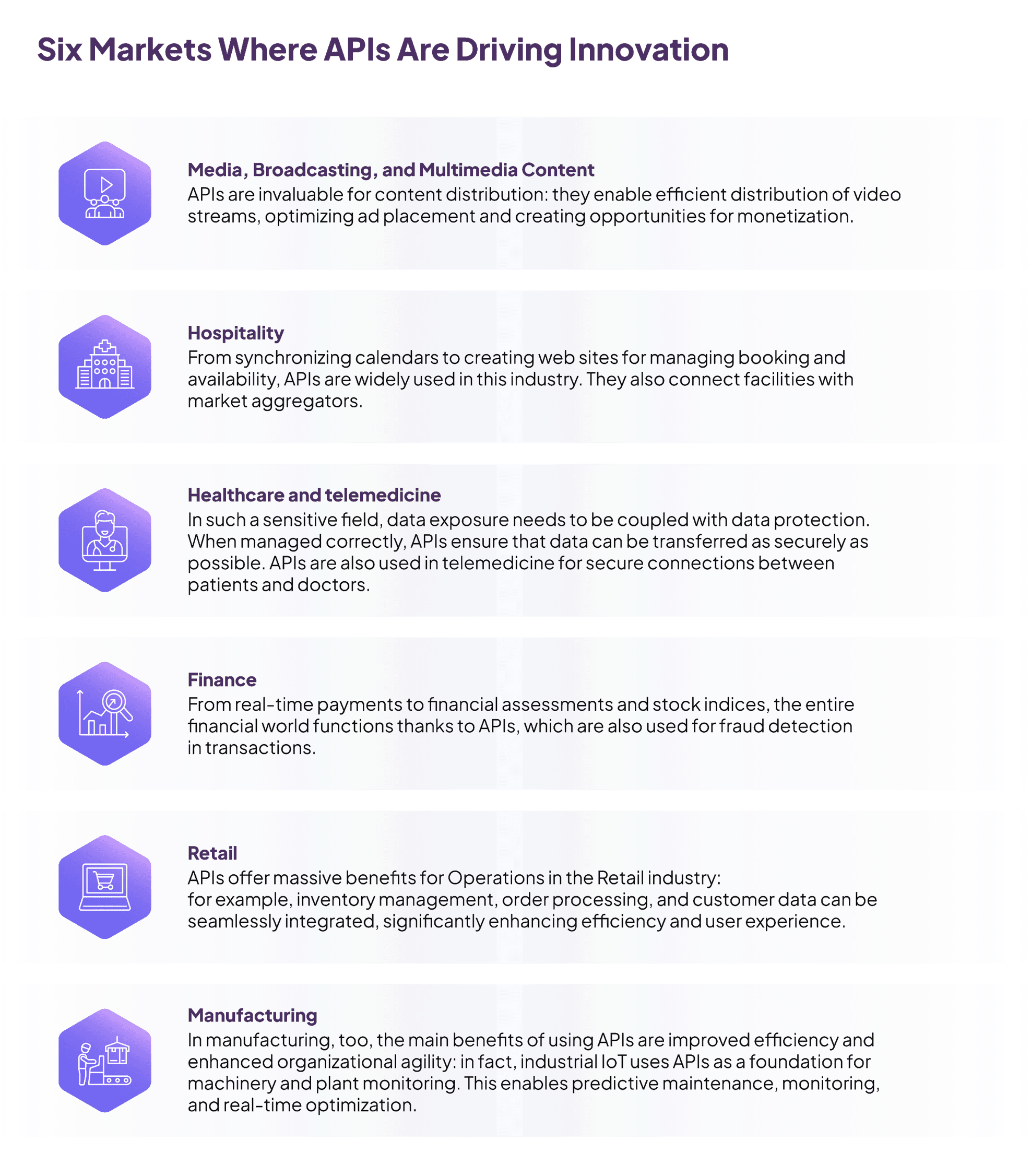
If we had to identify one key feature to demonstrate the advantages APIs bring to the digital transformation of enterprises, it would undoubtedly be their ability to enable integration. They were originally designed for this purpose, and they efficiently allow us to use (or to build, in more complex scenarios) a common language for all corporate assets, independent of platforms, vendors, and the technology used.
More specifically, APIs play a crucial role in acting as a bridge between different software systems (based on different approaches and of different ages). A typical example is the connection between legacy systems, that cannot be replaced or updated, and new technologies. This is vital for the acceleration process, as it allows companies to push even outdated tools into innovation when there are no viable alternatives.
Faster and more efficient development
When a company’s API Journey is well-designed, the benefits go beyond the ones we have just described. APIs allow standardization, both on the application side, and on the development and processes side. This generates also an organizational advantage, since all development activities, internal or external, begin to use a common language. Most importantly, the benefits and the acceleration effect are truly measurable in terms of efficiency: a well-governed system enables good practices like code and resource reuse and the automation of tasks such as code review, freeing up human and financial resources for further development and faster technological evolution.
Enterprise digital transformation through APIs: acceleration and stability
APIs are at the heart of the digital transformation of enterprises: they accelerate the innovation process and provide a solid technological foundation for the future. Thanks to their integration capabilities, APIs allow companies to be agile in reacting to continuous change and make the most of the opportunities offered by digitization.
The key to success in this field lies in building an appropriate API Journey that allows for the design and implementation of well-structured, interoperable, and scalable APIs, ensuring sustainable and continued growth.