Our post
Our post
The latest ApiShare posts

A vendor pitches, a deadline arrives, the architecture gets locked in. That works until something changes upstream and you realize the setup was built around assumptions nobody wrote down.
We help organizations design API architectures that hold up past the next contract renewal. It starts with the current state, not a vendor comparison matrix.
#APIGovernance #APIDesign #APIGateway #ApiShare

Pubblicato il:
A vendor pitches, a deadline arrives, the architecture gets locked in. That works until something changes upstream and you realize the setup was built around assumptions nobody wrote down.
We help organizations design API architectures that hold up past the next contract renewal. It starts with the current state, not a vendor comparison matrix.
#APIGovernance #APIDesign #APIGateway #ApiShare
Pubblicato il:

The ones nobody owns. No docs, no catalog entry, still answering requests.
They stay invisible until something breaks. Or until an AI agent finds them and uses them exactly as they are.
Give every digital product an owner and a place in the catalog, and the ghosts have nowhere to hide.
Happy Halloween 🎃
#Halloween #APIGovernance #AgenticAI #ApiShare
Pubblicato il:

It queries the catalog. Reads what’s available. Checks its own authorization level. Picks the right API, or MCP server, or agent. Updates its toolset when something new goes live.
No fixed lists. No manual updates. No one going back into the configuration every time the catalog changes.
A consumer agent that does discovery on its own. That requests access when it needs it. That works with what exists today, not with what someone hardcoded six months ago.
Would be something, right?
This is part of what’s coming in the next ApiShare release.
Pubblicato il:

Agents are already calling your APIs. Or they will be soon.
The question is whether what they find is solid. Well-documented APIs, clear governance, a defined operating model. Or gaps that nobody mapped because nobody thought to look.
Here’s the problem: agents don’t evaluate what they consume. They work with what’s there. A missing auth rule, an undocumented endpoint, an inconsistent design pattern. They don’t flag it. They use it.
You can’t govern what you don’t know. And if you don’t know where your API program actually stands, you’re handing agents a foundation you haven’t checked.
The API Maturity Assessment is a structured evaluation across three dimensions: API Design, API Management, and Operating Model. You get a maturity score, a gap analysis, a customized roadmap, and a demo of ApiShare to see what the end state looks like in practice.
One entry point. Real output. 6-month free license included.
Find out where you actually stand: https://www.apishare.cloud/api-maturity-assessment
#APIGovernance #APIManagement #DigitalGovernance #AgenticAI #APIStrategy #OperatingModel #ApiShare
Pubblicato il:

ApiShare wins the Kong Best Solution EMEA Partner Award.
Proud of this one. At the API & AI Summit in Los Angeles, Kong recognized ApiShare as Best Solution EMEA Partner. And on the same day, Rocco Caputo, our CEO, took the stage alongside Réda Kamar from Kong to talk about the strategic value of our partnership.
The core of what they presented: infrastructure alone is not enough, and governance alone is not enough. Kong handles runtime security, traffic routing, and operational visibility. ApiShare brings governance across the full API lifecycle, from design to production. Together, the two cover what enterprises actually need to build AI on solid foundations.
Grateful to Kong for the recognition. Thanks to Rocco Caputo and Felicia Marino, who represented ApiShare at the event, and to everyone on the team who made this possible.
#KongSummit #APIGovernance #APIManagement #ApiShare
Pubblicato il:

APIs are at the center of everything. They were before AI agents. Even more so now.
Managing APIs and governing them are not the same thing.
Managing means exposing, routing and securing traffic.
Governing means defining standards, managing the lifecycle, ensuring compliance, and making every Digital Product (whether an API, an MCP Server or an AI Agent) trusted, discoverable and ready for enterprise consumption.
That’s why Kong and ApiShare are partnering.
Together, we combine enterprise-grade API & AI connectivity with operational governance, helping organizations build AI initiatives that are secure, compliant and ready to scale.
Two sides of the same stack. Built for the Agentic Era.
#APIGovernance #APIManagement #AgenticAI #ApiShare #Kong
Pubblicato il:

You’re talking about agentic AI internally.
The question isn’t whether to adopt it. It’s whether your API ecosystem is ready for it.
Most teams find out the hard way. Swipe through to see what readiness actually looks like.
#APIGovernance #AgenticAI #APIMaturity #ApiShare
Pubblicato il:
You’re talking about agentic AI internally.
The question isn’t whether to adopt it. It’s whether your API ecosystem is ready for it.
Most teams find out the hard way. Swipe through to see what readiness actually looks like.
#APIGovernance #AgenticAI #APIMaturity #ApiShare
Pubblicato il:

Most organizations have governance in place for their APIs.
Ownership, lifecycle, access policies. Someone is responsible. Something gets tracked.
Then AI agents enter the picture. And they enter with a double role: they are new consumers of your digital ecosystem, and they are digital products that need to be governed themselves.
Both sides require the same infrastructure: a catalog that agents can query to discover what’s available, ownership models that extend to non-human identities, and processes that stay traceable even when the requests are generated automatically.
The technical layer moved faster than the organizational one. It usually does.
We wrote about what closing that gap requires in practice, and why ApiShare calls it Operational AI Governance.
🔗 https://www.apishare.cloud/blogs-detail/ai-agents-in-the-enterprise-ecosystem-extending-api-governance-processes
#APIGovernance #AgenticAI #OperatingModel #OperationalAIGovernance #ApiShare
Pubblicato il:

Most teams came back from the summer to find things where they left them.
The backlog. The open tickets. The API that was “almost ready” in June.
If your governance was in place, at least you know the state of your ecosystem. What’s cataloged, what’s owned, what’s changed while nobody was watching.
If it wasn’t, the summer didn’t pause anything. It just meant nobody was looking.
Good to be back.
#APIGovernance #AgenticAI #ApiShare
Pubblicato il:

Taking a summer break.
The APIs will keep running. We’ll be back in September with new content, updates, and a few things we’ve been working on.
Enjoy the break. 🌊
#ApiShare #SummerBreak
Pubblicato il:
Taking a summer break.
The APIs will keep running. We’ll be back in September with new content, updates, and a few things we’ve been working on.
Enjoy the break. 🌊
#ApiShare #SummerBreak
Pubblicato il:

ApiShare 2.1 is out!
This release builds on the governance and AI capabilities introduced in 2.0. The focus is on control and operational consistency — for admins and for the teams working inside the platform every day.
Two new features: automated user onboarding, which orchestrates account creation and access management through a single API call, and centralized visibility and filter configuration, which gives tenant admins direct control over what users see across Catalog and Workspace pages.
On top of that: Discovery Expert consolidation, improved invite and membership request management, expanded IP list support in subscriptions, and a security remediation pass.
🔗 Full release notes: https://www.apishare.cloud/release-note
#ApiShare #APIGovernance #ProductUpdate #AgenticAI
Pubblicato il:

Most API governance conversations stay technical. Tools, specs, catalogs, policies.
Those matter. But they don’t work without something underneath: clarity on who decides what, who owns what, and what happens when something goes wrong.
In organizations moving toward agentic AI, that clarity becomes more urgent. Agents act on the structure they find. If roles are ambiguous and processes aren’t defined, the agent doesn’t compensate. It operates on ambiguity and produces unpredictable results.
An operating model for API governance defines the organizational layer: ownership, decision rights, processes, metrics. It’s what makes the technical layer sustainable.
https://www.apishare.cloud/operating-model-design-and-implementation
#APIGovernance #OperatingModel #AgenticAI #ApiShare
Pubblicato il:

Before you run an AI agent on your APIs.
Three questions. One for the CTO, one for the CIO, one for the CISO.
They’re not the same question. The specs your CTO owns, the accountability model your CIO is responsible for, the access controls your CISO has in place — three different angles on the same gap.
Swipe to see where yours is. For the full picture: apishare.cloud
#AgenticAI #APIGovernance #AIGovernance #ApiShare
Pubblicato il:

Everyone’s deploying MCP Servers. Not everyone knows what governance means for them.
Are they APIs? Do the same rules apply? Where does the catalog fit in? We get these questions a lot.
Swipe through the FAQ.
#MCPServer #APIGovernance #AgenticAI #ApiShare
Pubblicato il:
Everyone’s deploying MCP Servers. Not everyone knows what governance means for them.
Are they APIs? Do the same rules apply? Where does the catalog fit in? We get these questions a lot.
Swipe through the FAQ.
#MCPServer #APIGovernance #AgenticAI #ApiShare
Pubblicato il:
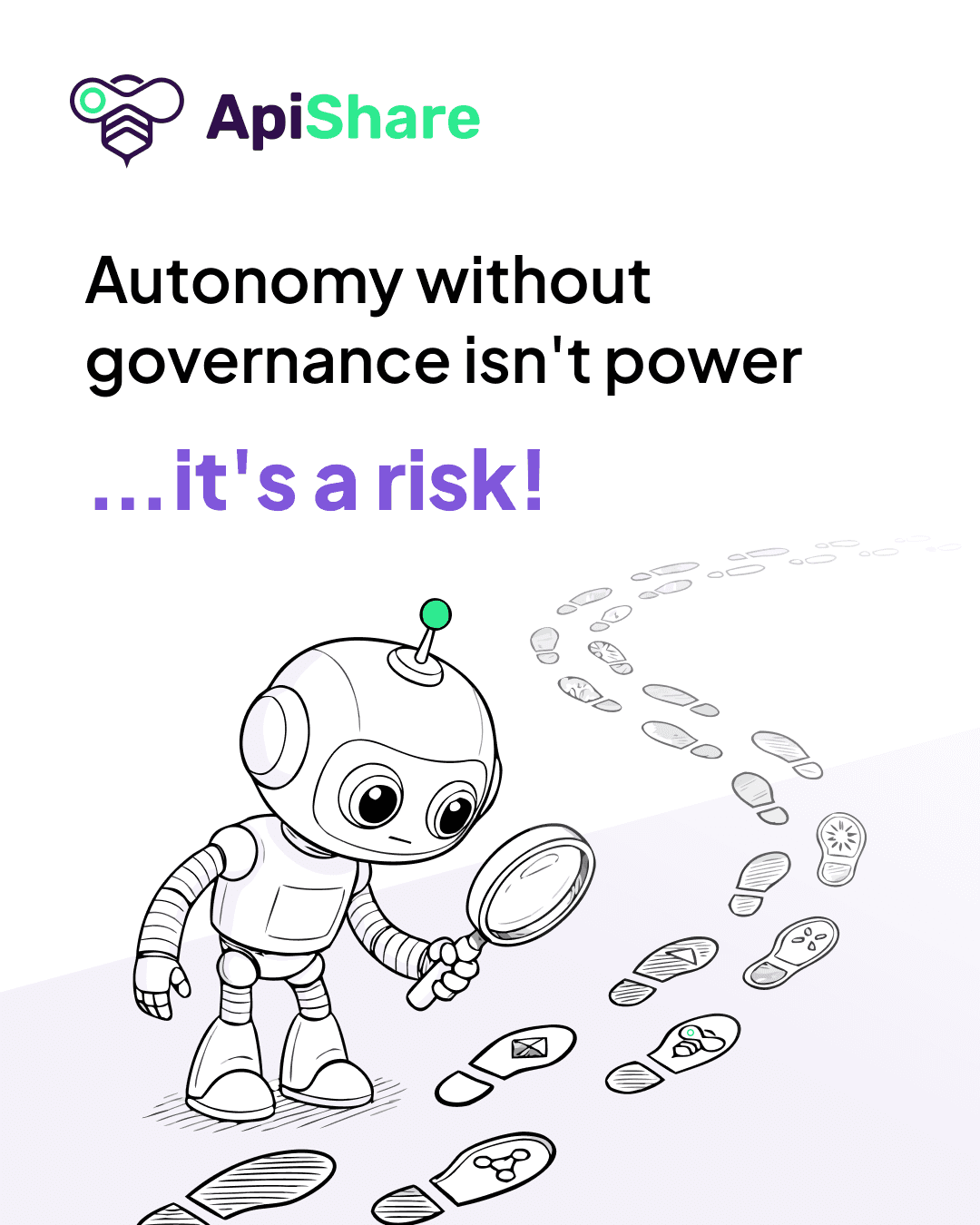
When an AI agent takes an action, who sees it?
Not the action itself. The chain. What triggered it, what it called, in what order, on what data, with what outcome.
Most organizations can answer that question for their applications. They have logs, owners, audit trails. The infrastructure exists.
What’s missing is the same infrastructure applied to agents. Agents that invoke APIs autonomously, chain operations nobody explicitly programmed, and move fast enough that manual analysis isn’t a real option after the fact.
The traceability of an agent starts with the traceability of what it exposes.
Autonomous doesn’t have to mean unobservable.
A well-governed ecosystem makes autonomy readable, not limited. Knowing what the agent can and cannot do, on which systems, with which outcome is what makes that autonomy sustainable over time.
We wrote about what this requires in practice. 👉 https://www.apishare.cloud/blogs-detail/autonomy-without-governance-isn-t-power-it-s-risk
#AgenticAI #APIGovernance #Observability #AIGovernance #ApiShare
Pubblicato il:

Most AI assistants in this space know about APIs. How they work in general, what good design looks like in theory.
That’s not what these two do.
The Discovery Expert knows your catalog. Ask it what’s available, what use cases are already covered, who manages what. Useful when a developer is about to build something that already exists. Also useful when an agent needs to find the right API before it does anything.
The Design Expert works earlier in the process, during the spec phase. Generate a draft from a design intent, fix a definition before the error propagates, fill a gap before an agent encounters it. All of it aligned to your organization’s specific standards and policies, not a generic checklist.
Both are in ApiShare 2.0.
→ https://www.apishare.cloud/blogs-detail/governance-by-design-why-governance-after-publication-no-longer-works
#ApiShare2 #DiscoveryExpert #DesignExpert #AgenticAI #APIGovernance
Pubblicato il:

We keep asking whether our APIs work.
The better question: are they good enough to build reliable agents on?
A developer figures things out. They read between the lines, check the docs, ask a colleague. When you instruct an agent to use an API, you don’t have that buffer. You define the behavior upfront, in code. If the spec has gaps, those gaps become assumptions baked into the agent.
Sometimes the assumptions hold. Sometimes they don’t. And when the API changes, you start over.
Swipe through the FAQ to see what agents actually need from an API.
→ https://www.apishare.cloud/blogs-detail/governance-by-design-why-governance-after-publication-no-longer-works
#APIDesign #AgenticAI #APIGovernance #MCPServer #ApiShare
Pubblicato il:

apidays Amsterdam. Two days on what actually matters.
The theme this year is Sovereign Intelligence — how APIs become the bridge between AI regulation and accountable, machine-readable services. Public sector, private sector, same question: how do you make AI work without losing control of what it does?
That question sits exactly where we work every day.
Biagio Zampogna is there representing ApiShare. 📍
Governance doesn’t start when something goes wrong. It starts here.
#apidays #APIGovernance #AgenticAI #SovereignIntelligence #ApiShare
Pubblicato il:

Most organizations govern their APIs after the fact.
They publish, then align. Release, then document. Deploy, then fix what doesn’t match the standard. With human developers consuming those APIs, this works. Badly, but it works. Developers adapt. They ask questions. They work around gaps.
AI agents don’t.
An agent uses what it finds, exactly as it is. A vague parameter description isn’t a minor annoyance. It’s an input to behavior nobody designed. An undocumented edge case isn’t a known issue. It’s a variable that produces results nobody can fully explain after the fact.
The window for correction collapses. The cost of getting it wrong upstream goes up.
Governance by design means the standards are where the decisions happen, in the design workspace, before the product is published. Not in an excel that gets read once and forgotten.
That’s what the article we published this week is about.
👉 https://www.apishare.cloud/blogs-detail/governance-by-design-why-governance-after-publication-no-longer-works
#APIGovernance #GovernanceByDesign #AgenticAI #DigitalProducts #ApiShare
Pubblicato il:

Most organizations don’t start from scratch. They already have APIs. Dozens, sometimes hundreds. Built at different times, by different teams, with different conventions, or none at all. They respond to requests, but they don’t follow the same patterns, they’re not documented consistently, and very few were designed expecting AI agents to invoke them autonomously.
Retrofitting governance onto an existing ecosystem is harder than building it in from the start. It’s also where most organizations actually are.
Our API Design & Development service starts from what you already have. We audit the ecosystem, identify where standards and consistency break down, and redesign toward something coherent — something that works for developers today and for automated systems that consume specifications exactly as they are.
Discover the service: https://www.apishare.cloud/custom-api-design-development
#APIDesign #APIGovernance #AgenticAI #ApiShare
Pubblicato il:

MCP Servers are getting a lot of attention. Most of it is about implementation: how to configure them, which libraries to use, how to expose them. Very little of it is about what happens when an agent actually starts using them.
An MCP Server exposes enterprise capabilities (functions, data, workflows) in a form agents can discover and invoke dynamically. Not every interaction is orchestrated step-by-step by a developer anymore.
The agent uses what it finds. As-is.
Incomplete specs aren’t friction anymore. They’re inputs to behaviors nobody explicitly designed and that become difficult to fully reconstruct after the fact.
The governance questions are the same ones that apply to APIs: who owns this, what does it expose, who can invoke it, what gets logged. The difference is when you answer them. Before the agents run, or after something goes wrong.
We wrote the piece that kept not existing on this topic: https://www.apishare.cloud/blogs-detail/mcp-servers-what-they-are-what-they-expose-and-why-governance-matters
#MCP #AgenticAI #APIGovernance #ApiShare
Pubblicato il:
Everyone is talking about AI agents. Few are asking what they actually run on.
Agents don’t access abstract systems. They access APIs, services, structured data, autonomously and continuously, without asking questions. They work with what they find, exactly as it is: incomplete specs, scattered documentation, inconsistent naming and everything else that comes with it.
With a human developer, this produces inefficiency. With an AI agent, it produces behavior that’s hard to trace and even harder to explain.
The point of control shifts. It shifts to the beginning, to design, to the quality of what enters the ecosystem in the first place. Not downstream.
That’s the argument at the center of our latest article.
🔗 https://www.apishare.cloud/blogs-detail/before-agents-there-are-digital-products.-apishare-2.0-and-the-governance-that-enables-ai
#AgenticAI #APIGovernance #DigitalProducts #ApiShare
Pubblicato il:
Most organizations have API design guidelines. Very few actually follow them.
Not because people don’t care. But because a document is not a guardrail. Standards written in a Confluence page or a PDF get interpreted differently by every team, every project, every developer.
The result is an ecosystem that technically works, but not together.
The ApiShare API Designer embeds your organization’s rules directly into the design experience. The guidelines are no longer something to read and remember. They’re something the tool applies for you, at the moment the decisions are made.
Swipe to see how it works.
#APIDesign #ApiShare #APIGovernance #DesignOriented #AgenticAI
Pubblicato il:
There’s no single path to API Governance.
Some organizations start from the top. They already have APIs, teams, processes in place and they need to bring order to what exists, make it governed, make it consistent.
Others start from the design itself. They need governance to emerge from the moment an API is created, not to be retrofitted afterward.
Neither approach is wrong. They’re just different starting points, and the right one depends on where your organization actually is, not where a framework says it should be.
Swipe to see how the two models work in practice.
Not sure which one fits you? Start with an API Maturity Assessment:
🔗 https://www.apishare.cloud/business-value-assessment
#APIGovernance #ApiShare #APIDesign #DigitalTransformation #AgenticAI
Pubblicato il:

Perché l’AI ha bisogno di API ben governate?
Perché l’AI non inventa, impara. Apprende da ciò che legge e da ciò che può fare attraverso le API.
Se lungo questo percorso incontra incoerenze, ambiguità o logiche diverse tra sistemi, non le corregge. Le formalizza.
Il risultato non è un errore casuale, ma un sistema coerente… nelle sue incoerenze.
Gli agenti AI operano, orchestrano e decidono attraverso le API.
Per questo, senza governance, l’autonomia non scala. Scala il rischio.
Approfondisci su:
https://www.apishare.cloud/it/blogs-detail/api-governance-and-ai-agents
Pubblicato il:
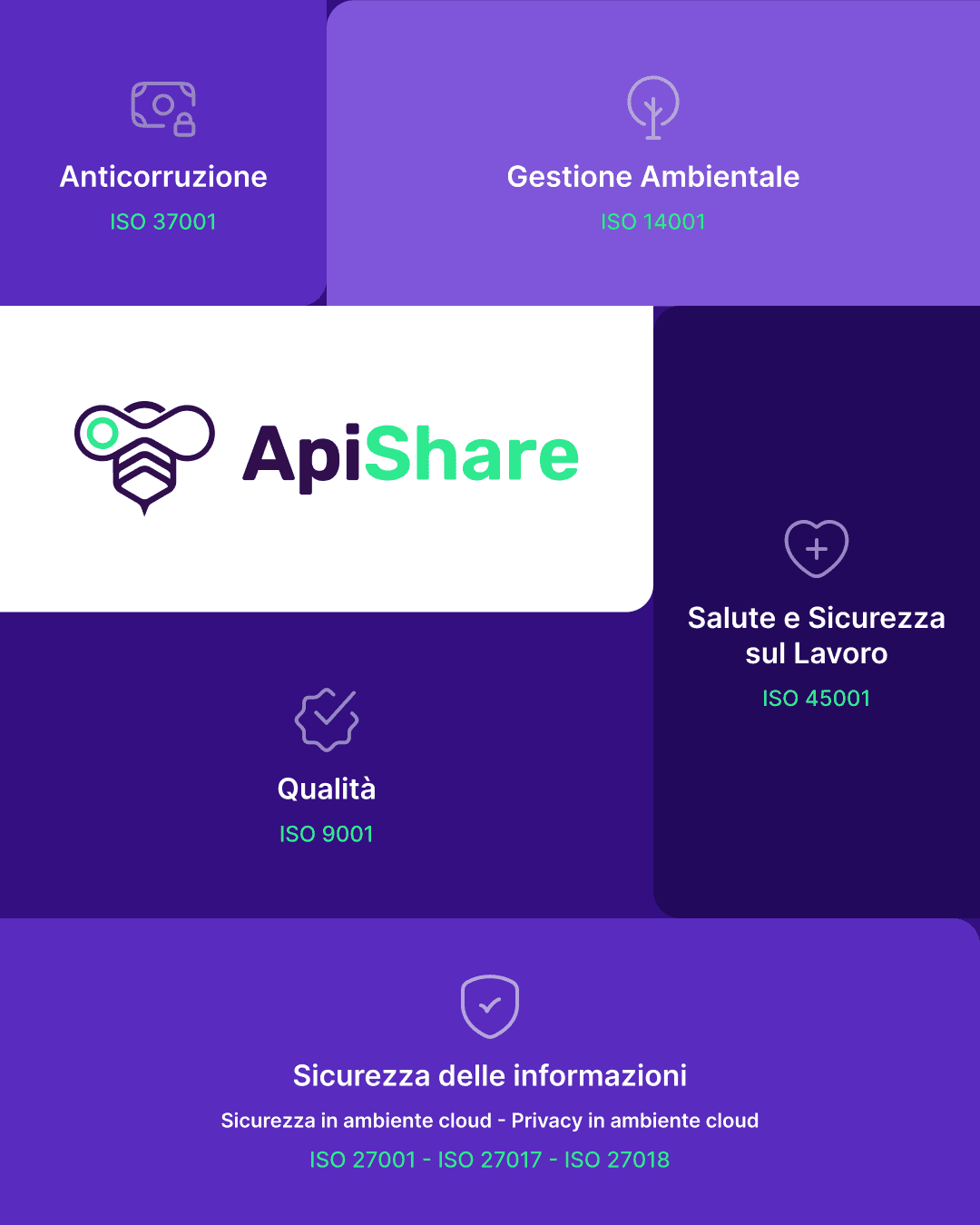
Gli agenti AI sono efficaci quanto i prodotti digitali a cui accedono: strutturati, documentati, governati.
La stessa logica vale per chi costruisce la piattaforma.
Non puoi chiedere rigore agli ecosistemi che aiuti a governare se non sei disposto ad applicarlo prima a te stesso: ai tuoi processi, alla sicurezza delle informazioni, alla qualità di ciò che consegni.
In ApiShare la governance non è solo il prodotto. È il modo in cui lavoriamo: ▪️ Sicurezza delle informazioni e privacy in cloud ▪️ Qualità dei processi ▪️ Gestione ambientale ▪️ Salute e sicurezza sul lavoro ▪️ Anticorruzione
Governed knowledge is strategy. A partire da noi.
🔗 https://www.apishare.cloud/certifications
#ApiShare #APIGovernance #Compliance
-
AI agents are only as effective as the digital products they access: structured, documented, governed.
The same logic applies to the people who build the platform.
You can’t ask for rigour from the ecosystems you help govern if you’re not willing to apply it to yourself first — to your processes, your information security, the quality of what you deliver.
At ApiShare, governance isn’t just the product. It’s how we work:
▪️ Information security and cloud privacy ▪️ Process quality ▪️ Environmental management ▪️ Health and safety at work ▪️ Anti-corruption
Governed knowledge is strategy. Starting with us.
🔗 https://www.apishare.cloud/certifications
#ApiShare #APIGovernance #Compliance
Pubblicato il:
Quando sai chi chiama un’#API e perché, le regole bastano.
Quando lo decide un #agenteAI in autonomia, serve qualcosa di diverso: non più semplici regole, ma un’architettura che renda l’autonomia agentica governabile.
Gli AI Agent ragionano, incatenano decisioni e agiscono su decine di API senza supervisione umana. Il sistema non è più procedurale e predittivo, è adattivo per natura.
Nel nostro ultimo articolo esploriamo questo shift e perché le organizzazioni che lo capiscono per prime trasformano la governance da ostacolo a vantaggio competitivo.
Leggi l’articolo
https://www.apishare.cloud/it/blogs-detail/when-apis-meet-agentic-ai-a-governance-story
-
When you know who calls an API and why, rules are enough.
When an AI Agent decides autonomously, you need something different: not more rules, but an architecture that makes agentic autonomy governable.
AI agents reason, chain decisions, and act across dozens of APIs without human supervision. The system is no longer procedural and predictive it’s adaptive by nature.
In our latest article, we explore this shift and why the organizations that grasp it first turn governance from a bottleneck into a competitive advantage.
Read the article
https://www.apishare.cloud/it/blogs-detail/when-apis-meet-agentic-ai-a-governance-story
Pubblicato il:
Adottare uno strumento di API Governance può sembrare complesso.
Sistemi diversi, architetture stratificate, integrazioni “storiche” di cui nessuno ricorda più l’origine.
La buona notizia?L’integrazione non deve essere un atto di coraggio.
Con ApiShare Ecosystem Integration, ApiShare si adatta alla tua architettura: non ti chiede di cambiarla, ma di valorizzarla.
Partiamo da ciò che hai, lo analizziamo con cura e progettiamo l’integrazione più semplice, solida e sostenibile.
Un percorso strutturato che riduce rischi, allinea team e rende l’adozione della API Governance molto più naturale di quanto sembri.
👉 Scopri come funziona:
https://www.apishare.cloud/it/apishare-ecosystem-integration
-
Adopting an API Governance platform can feel complicated.
Different systems, layered architectures, and “historical” integrations no one really remembers anymore.
The good news? Integration doesn’t have to be an act of bravery.
With AApiShare Ecosystem Integration, ApiShare adapts to your architecture, it doesn’t ask you to change it, but to elevate it.
We start from what you already have, analyze it carefully, and design the simplest, most solid, and most sustainable integration.
A structured approach that reduces risks, aligns teams, and makes API Governance adoption far more natural than it seems.
👉 Learn how it works:
https://www.apishare.cloud/it/apishare-ecosystem-integration
Pubblicato il:

Progettare una APi non significa farla funzionare, significa farla parlare la stessa lingua delle altre.
Il vero problema non sono le API che non rispondono.
Sono le API che rispondono ognuna a modo suo: nomi diversi, formati diversi, documentazioni diverse.
Il risultato? Un ecosistema che funziona… ma non insieme.
Ecco perché la progettazione è il primo atto di governance.
🔽 Scopri perché non puoi governare ciò che non è standardizzato e perché tutto parte dalla progettazione.
-
Designing an API isn’t about making it work, it’s about making it speak the same language as the others.
The real issue isn’t APIs that fail to respond.
It’s the ones that respond each in their own way: different names, different formats, different documentation styles.
The result? An ecosystem that works… but not together.
That’s why design is the first act of governance.
🔽 Discover why you can’t govern what isn’t standardized and why everything starts with proper API design.
Pubblicato il:
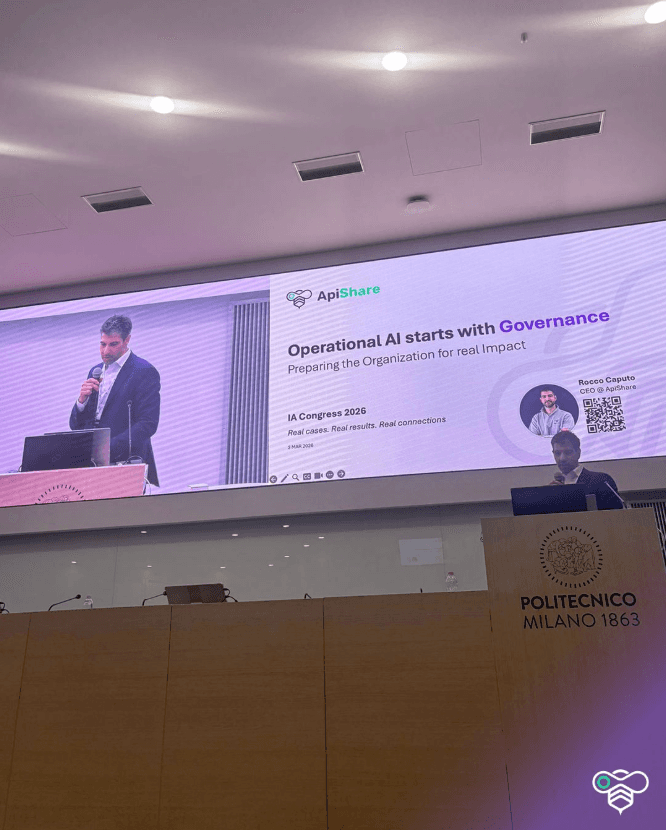
Con oggi si chiudono questi due giorni all’Intelligent Automation Congress 2026. Due giorni intensi, a due velocità: ad ascoltare idee, esperienze e prospettive di chi lavora ogni giorno sull’automazione intelligente e a portare la nostra visione.
Un tema è tornato con forza, in ogni conversazione: come si governa l’AI?
La risposta che portiamo è questa: parte dalle API.
Gli #agentiAI agiscono, orchestrano e decidono attraverso le #API. È lì che prendono informazioni, è lì che eseguono azioni. Se quell’infrastruttura non è governata, tracciabile, sicura, sotto controllo, non puoi governare ciò che ci passa sopra.
L’API Governance non è un dettaglio tecnico: è la condizione necessaria per affrontare l’AI Governance. Il punto da cui tutto il resto dipende.
Un grazie al team ApiShare presente oggi, Rocco Caputo, Felicia Marino, Maurizio Viziano, Giorgio Sismanidis, Federico Oggioni e a tutti coloro che hanno condiviso esperienze e visioni con noi.
La domanda che portiamo a casa è sempre la stessa: tu sei pronto?
Scorri le foto per un assaggio di questi due giorni 👇
-
Two intense days, lived at two speeds: listening to ideas, experiences and perspectives from those working every day on intelligent automation, and sharing our own vision.
One question kept coming up in almost every conversation: how do we govern AI?
Our answer is simple: it starts with APIs.
#AIAgents act, orchestrate and make decisions through #APIs.
That’s where they get information. That’s where they trigger actions.
If that infrastructure is not governed, traceable, secure and under control, then you cannot govern what runs on top of it.
API Governance is not a technical detail. It is the necessary foundation for AI Governance, the point everything else depends on.
A big thank you to the ApiShare team who joined us today, Rocco Caputo, Felicia Marino, Maurizio Viziano, Giorgio Sismanidis, Federico Oggioni and to everyone who shared insights and perspectives with us.
The question we bring home is always the same: Are you ready?
Scroll through the photos for a glimpse of these two days
Pubblicato il:
Gli agenti AI non lavorano nel vuoto: interagiscono, collegano, orchestrano.
E nelle loro catene d’azione, le #API giocano un ruolo fondamentale.
È qui che entra in gioco la governance: senza regole chiare, l’autonomia diventa fragilità.
Con una struttura solida, diventa automazione reale, pronta a scalare.
Nel nostro articolo raccontiamo perché l’infrastruttura API è la vera leva dell’AI operativa e come ApiShare prepara gli ecosistemi a questo nuovo modo di lavorare.
🔗 Leggi l’articolo: https://www.apishare.cloud/it/blogs-detail/api-governance-and-ai-agents
-
AI agents don’t operate in the void: they interact, connect, orchestrate. And in those action chains, APIs play a fundamental role.
That’s where governance becomes essential: without clear rules, autonomy turns into fragility. With the right foundations, it becomes real, scalable automation.
In our article, we explore why the API layer is the true enabler of operational AI and how ApiShare prepares ecosystems for this new way of working.
🔗 Read the article: https://www.apishare.cloud/it/blogs-detail/api-governance-and-ai-agents
Pubblicato il:

Il 3 e 4 marzo saremo tra i protagonisti dell’Intelligent Automation Congress 2026, la 10ª edizione del principale appuntamento italiano dedicato all’automazione intelligente e agli AI agent, ospitato al Politecnico di Milano in collaborazione con gli Osservatori Digital Innovation.
Tutti parlano di come costruire agenti AI più capaci, più veloci, più autonomi. Noi portiamo una domanda diversa: cosa succede quando quegli agenti operano senza una struttura che li renda osservabili, sicuri e governabili?
L’autonomia senza governance non è potere. È rischio.
📍 Politecnico di Milano – Bovisa Campus
🗓️ 3–4 marzo 2026
Se vuoi portarti a casa qualcosa di buono (letteralmente 🍯), partecipa alla Gaming Challenge dell’evento: vinci premi, scala la leaderboard, e magari passa a trovarci.
🎮 Scopri la challenge: https://www.intelligentautomationcongress.org/bingo/preview
🔗 Scopri l’evento: https://www.intelligentautomationcongress.org/ia-congress-2026.php
-
On March 3rd and 4th we’ll be part of the Intelligent Automation Congress 2026, the 10th edition of Italy’s leading event on intelligent automation and AI agents, hosted at Politecnico di Milano in collaboration with the Osservatori Digital Innovation.
Everyone is talking about building AI agents that are faster, smarter, more autonomous. We’re bringing a different question: what happens when those agents operate without a structure that makes them observable, secure and governable?
Autonomy without governance isn’t power. It’s risk.
📍 Politecnico di Milano – Bovisa Campus
🗓️ March 3–4, 2026
And if you want to take something good home (literally 🍯), join the event’s Gaming Challenge: win prizes, climb the leaderboard — and come say hi while you’re at it.
🎮 Discover the challenge:
https://www.intelligentautomationcongress.org/bingo/preview
🔗 Discover the event:
https://www.intelligentautomationcongress.org/ia-congress-2026.php
Pubblicato il:

When we talk about #AI, it’s not just about models. It’s about choices.
Architectural choices. Governance choices.
Choices that determine whether AI becomes a real advantage
or a problem that’s hard to control.
As AI enters real, API-driven systems, governance becomes a structural requirement, not a secondary concern.
This is the context in which we’re starting a path with David Roldán Martínez, who works on the governance and architectural foundations needed to bring AI into real, API-driven systems.
An alignment on how AI should be designed to operate reliably in complex environments.
Stay tuned!
-
Quando si parla di #AI, non è solo una questione di modelli. È una questione di scelte.
Scelte di architettura. Scelte di governance. Scelte che determinano se l’AI diventa un vantaggio reale o un problema difficile da gestire.
Quando l’AI entra in sistemi reali, basati su API, la governance diventa un requisito strutturale, non un dettaglio secondario.
È in questo contesto che nasce il percorso con David Roldán Martínez,
che lavora sui fondamenti di governance e architettura necessari
per portare l’AI in ecosistemi API-driven reali.
Un allineamento su come l’AI debba essere progettata per operare in modo affidabile in contesti complessi.
Stay tuned!
Pubblicato il:
Tutti dicono di "esporre una API", peccato che ognuno intenda qualcosa di diverso!
Per alcuni è un URL. Per altri un toggle da attivare. Per altri ancora… un compito automatico del Gateway.
👉 La verità? Dietro quella parola c’è molto più design, più scelte e più architettura di quanto sembri.
E lo stesso vale per il ruolo dell’API Gateway: spesso celebrato come “la soluzione”, quasi mai compreso per ciò che realmente è (e per ciò che non è).
Se lavori con API, integrazioni o microservizi, questa è una di quelle domande che vale la pena guardare da vicino: cosa significa davvero esporre una API? E cosa fa, davvero, un API Gateway?
🔽 Scorri e scopri perché il modo in cui “apri una porta” può cambiare tutto.
-
Everyone talks about “exposing an API,” but everyone seems to mean something different.
For some, it’s just a URL. For others, a toggle to switch on. And for many… something the Gateway magically takes care of.
👉 The truth? There’s far more design, far more decisions, and far more architecture behind that word than it seems.
And the same goes for the API Gateway: often celebrated as “the solution,” yet rarely understood for what it truly is (and what it isn’t).
If you work with APIs, integrations or microservices, this is one of those questions worth taking a closer look at: What does it really mean to expose an API? And what does an API Gateway actually do?
🔽 Scroll to discover why the way you “open a door” can change everything.
Pubblicato il:
In molte aziende le API ci sono. Ma non parlano la stessa lingua.
Alcune seguono gli standard. Altre… le “tradizioni locali”. C’è chi usa le best practice e chi usa la memoria storica del team.
Il risultato? Integrazioni fragili, tempi lunghi, ecosistemi difficili da far scalare.
È qui che entra in gioco il design. Quello fatto bene.
Con API Design & Development, ApiShare aiuta le organizzazioni a costruire API nate per funzionare.
👉 Scopri il servizio: https://www.apishare.cloud/it/custom-api-design-development
-
In many companies, APIs already exist. They just don’t speak the same language.
Some follow standards. Others… follow “local traditions.” Some rely on best practices. Others rely on team folklore.
The result? Fragile integrations, long delivery times, and ecosystems that simply don’t scale.
This is where good design makes the difference.
With API Design & Development, ApiShare helps organizations build APIs that are born to work reliably, consistently, and at scale.
👉 Discover the service: https://www.apishare.cloud/it/custom-api-design-development
Pubblicato il:
Quando è stata l’ultima volta che hai cercato un’API… per risolvere un problema?
Di solito cerchiamo cosa fa un’API. Molto più raramente perché usarla e insieme a quali altre.
Nel nuovo articolo analizziamo perché il passaggio ad un catalogo API use case-oriented sta diventando cruciale per chi progetta ecosistemi API oggi, soprattutto in un contesto in cui AI e standard come Arazzo stanno alzando l’asticella.
👉 Leggi l’articolo completo: https://www.apishare.cloud/it/blogs-detail/from-api-catalog-to-use-case-catalog
-
When was the last time you looked for an API… to actually solve a problem?
Most of the time, we search for what an API does.
Much more rarely do we ask ourselves why we should use it and which other APIs it should work with.
In our new article, we explore why moving toward a use case–oriented API catalog is becoming essential for anyone designing modern API ecosystems, especially now that AI and standards like Arazzo are raising the bar for interoperability and automation.
👉 Read the full article: https://www.apishare.cloud/it/blogs-detail/from-api-catalog-to-use-case-catalog
Pubblicato il:
Fai ordine nella tua governance API!
API Management Platform Setup & Maintenance è il servizio ApiShare che accompagna le organizzazioni dalla scelta e configurazione della piattaforma alla sua gestione operativa continua.
Un percorso strutturato che traduce i principi di API Governance in un modello concreto, scalabile e realmente adottabile: ruoli chiari, processi standard, strumenti integrati e governance misurabile.
Dai struttura alla governance. Trasforma l’API Management in valore.
👉 Scopri il servizio:
https://www.apishare.cloud/api-management-platform-setup-and-maintenance
-
Bring clarity to your API governance!
API Management Platform Setup & Maintenance is the ApiShare service that guides organizations from choosing and configuring their API platform to its continuous operational management.
A structured journey that translates governance principles into a concrete, scalable, and truly adoptable model: clear roles, standardized processes, integrated tools, measurable governance.
Structure your governance. Turn API Management into business value.
👉 Learn more:
https://www.apishare.cloud/api-management-platform-setup-and-maintenance
Pubblicato il:
L’Intelligenza Artificiale non è più un’opzione. Ma senza le giuste fondamenta, resta solo teoria.
Agli #ApiDays abbiamo visto una cosa molto chiara: gli agenti AI stanno diventando sempre più centrali, capaci di agire, orchestrare servizi ed eseguire processi reali.
E lo fanno in un solo modo: attraverso le API.
Nel nostro ultimo articolo raccontiamo perché:
- le API sono le vere colonne portanti dell’AI operativa
- senza API governance, l’AI non scala (e non è sicura)
- governare oggi è una scelta strategica, non rimandabile
ApiShare abilita ecosistemi pronti per agenti intelligenti, non solo per sviluppatori.
Meno hype. Più sostanza.
🔗 Leggi l’articolo completo: https://www.apishare.cloud/it/blogs-detail/api-governance-and-ai-agents
-
AI is no longer optional. But without solid foundations, it’s just theory.
At API Days, one thing was clear: AI agents are becoming key players acting, orchestrating services, and executing real processes.
And they do it one way only: through APIs.
In our latest article, we explain why:
- APIs are the backbone of operational AI
- Without API governance, AI doesn’t scale (or stay secure)
- Governance today is a strategic, not optional, choice
ApiShare enables ecosystems designed for intelligent agents—not just developers.
Less hype. More substance.
🔗 Read the full article: https://www.apishare.cloud/it/blogs-detail/api-governance-and-ai-agents
Pubblicato il:

Perché le API interne sono diverse dalle API destinate all’integrazione con Partner e sistemi esterni?
Le API interne funzionano perché parlano un linguaggio “di casa”.
Quelle esterne devono farsi capire da chi è fuori.
Ed è lì che tutto cambia: esposizione, sicurezza, comunicazione, controllo.
Aprire un’API al mondo non è un click. È una scelta di progettazione e di governance.
Perché quando esci dalla scatola, ogni dettaglio fa la differenza.
Governare quei dettagli non è opzionale.
-
Why are internal APIs different from those designed for partners and external systems?
Because internal APIs speak the company’s native language.
External ones need to be understood by outsiders.
That changes everything: exposure, security, communication, control.
Opening up an API isn’t a click. It’s a design and governance choice.
Because once you step outside the box, every detail matters.
And governing those details isn’t optional.
#API #APIGovernance #APIDesign #ApiShare
Pubblicato il:

The way we use APIs today assumes someone already knows where to find them and how to use them.
AI Agents work differently: they need reliable information, structured documentation, and trusted digital assets to interpret possibilities, not just follow predefined instructions.
What is the role of API governance when APIs are no longer used only by applications, but by autonomous entities?
ApiShare is ready to answer and to give #AIAgents everything they need.
👉 Stay tuned.
#ApiShare #AgenticAI #APIs
-
L’uso che facciamo oggi delle API presuppone che qualcuno sappia già
dove trovarle e come usarle.
Gli AI Agent funzionano diversamente: devono poter contare su informazioni affidabili, documentazione strutturata, asset digitali pronti all’uso per interpretare possibilità, non seguire istruzioni rigide.
Qual è il ruolo dell’API Governance quando le API non sono più usate solo dalle applicazioni, ma da entità autonome e intelligenti?
ApiShare è pronta a rispondere…e a fornire agli #AIAgent tutto ciò di cui hanno bisogno.
👉 Stay tuned.
Pubblicato il: